In the News
Back02.22.16
Board Visits Funding Corp and D.C. Delegation
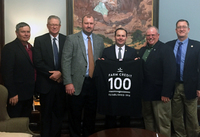
The first week of February, Western AgCredit's Board of Directors along with President Richard Weathered went to New York and D.C. to attend training, visit Utah's delegation on Capitol Hill and help commemorate Farm Credit's Centennial.
While in New York, they visited the Funding Corp and learned more about how the Farm Credit System is funded. In D.C., they visited Utah's Congressional Delegation and discussed with them what Western AgCredit contributes to Utah's economy. They also talked to them about 100 years of Farm Credit and asked the delegation to co-sponsor the resolution congratulating Farm Credit for reaching their Centennial.
They also were there when they unveiled the contents of the time capsule buried in 1967 to celebrate the 50th anniversary of the establishment of the Farm Credit System in Larned, KS. Included in the capsule were predictions of the future of agriculture by the 12 Federal Land Bank presidents of that time, a copy of the Bible, a flag, documents pertaining to the first loan issued in 1917 to Stockwell and a 1967 copy of High Plains Journal featuring the history of the Federal Land Bank at the time.
The 1967 predictions accurately identified some of the most prominent drivers of agricultural finance today, including:
• Complexity and Sophistication of Modern Farming Operations – "Successful farming in the future increasingly will demand a high degree of training and skill…not only in production techniques, but also in business and financial management."
• Growth in Farm Size – "Million dollar operations will be more common than hundred thousand dollar operations are today. This of course will necessitate the use of more credit."
• Modern, Market-based Risk Management Practices – "The more sophisticated farmers will actively participate in hedging practices on the livestock and commodity futures market, protecting themselves against adverse price movements both on what they buy and what they sell."
• Increased Efficiency & Production – "Contractual relationships between producers and processors will be commonplace. The ability to produce products with a high degree of uniformity in accordance with specified characteristics will make contracting very practical."
• Technological Advances – "Remote control by either man or computer will be used in field work rather extensively.