

Global AgriTrends
Back12.30.25
2025: What a YEAR!
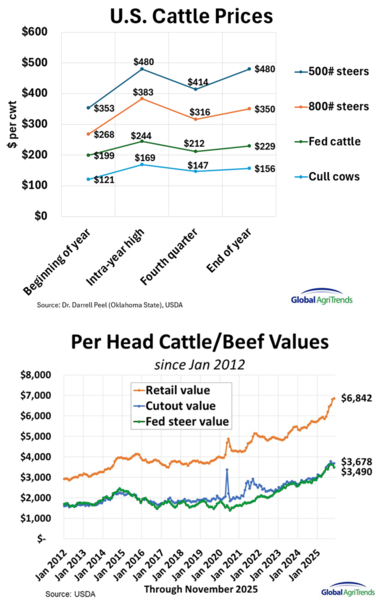
2025 began with some new Trump’s tariff threats, subdued optimism for cattle prices, currently at record highs, and cautious optimism due to a mostly negative futures curve (deferred cattle futures lower than current prices).
On the first trading day of 2025 (Jan 2), December fed cattle futures were trading at $191/cwt. By October 16th they peaked at $248/cwt (up 30%), but ended the year here at $229/cwt. That is a $770 per head swing in the value of fed cattle during 2025.
Calf prices (500#) began the year around $353, rising to $480, falling to $414, but ending the year here right near the annual high. A 500 pound steer at $480/cwt = $2,400.
Feeder cattle (800#) followed that pattern but ended 2025 at $350/cwt, short of their mid-year high ($383/cwt).
The most incredible story in the cattle and beef complex has been the surge in consumer demand. Consumer prices have doubled since mid-2017 on a dollars-per-head value, rising from $3,400 per head in mid-2017 to $6,842 per head in November 2025; to be fair, that value has risen with carcass weights as well.
But with retail beef prices topping $9.40/lb in November, the demand surge is real.
Whether it is due to higher grading percentages, increased quality improvements throughout the cattle/beef chain, or just a change in consumer tastes and preferences, this is a clear instance of “It’s different this time”. Keep that in mind as you dial in expectations for cattle and beef prices going forward. This industry is fueled with consumer dollars, not just from America, but also from around the world. And U.S. grainfed beef is a global standard for high quality.
Per capita beef supplies were stable over the past 5 years, even as the cowherd declined. That was due to higher carcass weights, drought induced slaughter, and bigger imports. As you flip the calendar to 2026, know that production is now dropping and supplies will tighten. All indications point to higher prices ahead.
My predictions: 2026 will see the cycle high in prices (calves, feeders, and fed cattle). And the slow pace of herd rebuilding, combined with strong consumer demand (and declining imports) will sustain these prices better than expected beyond 2026. Also, cycle lows out toward 2030 will be supported well above historical levels; pencil those 2030-ish cycle low calf prices above $260/cwt.
Happy New Year!
Brett Stuart
